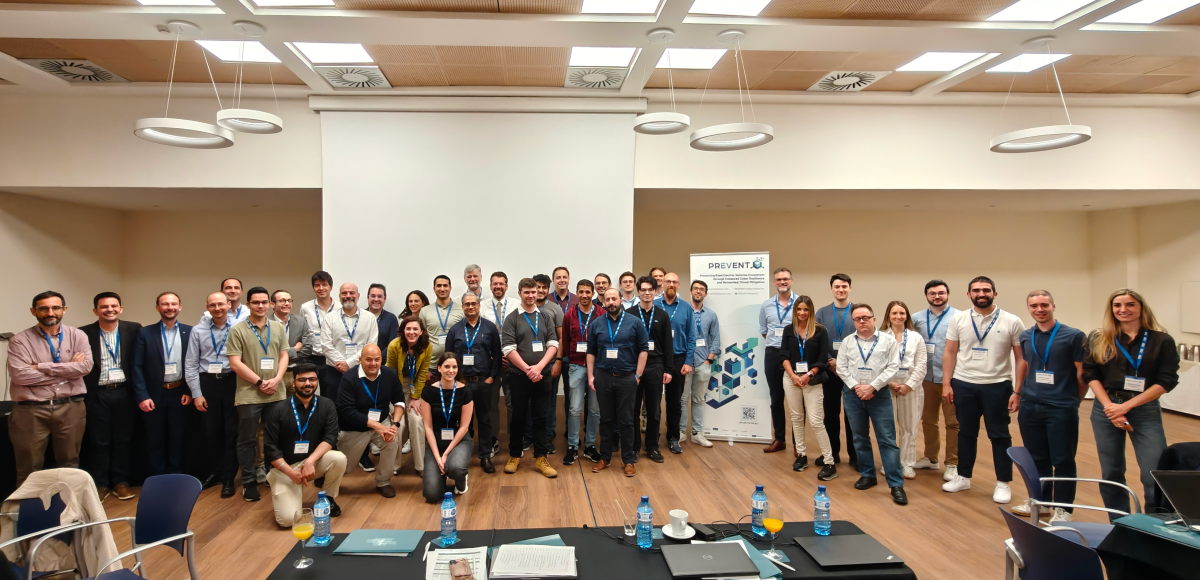

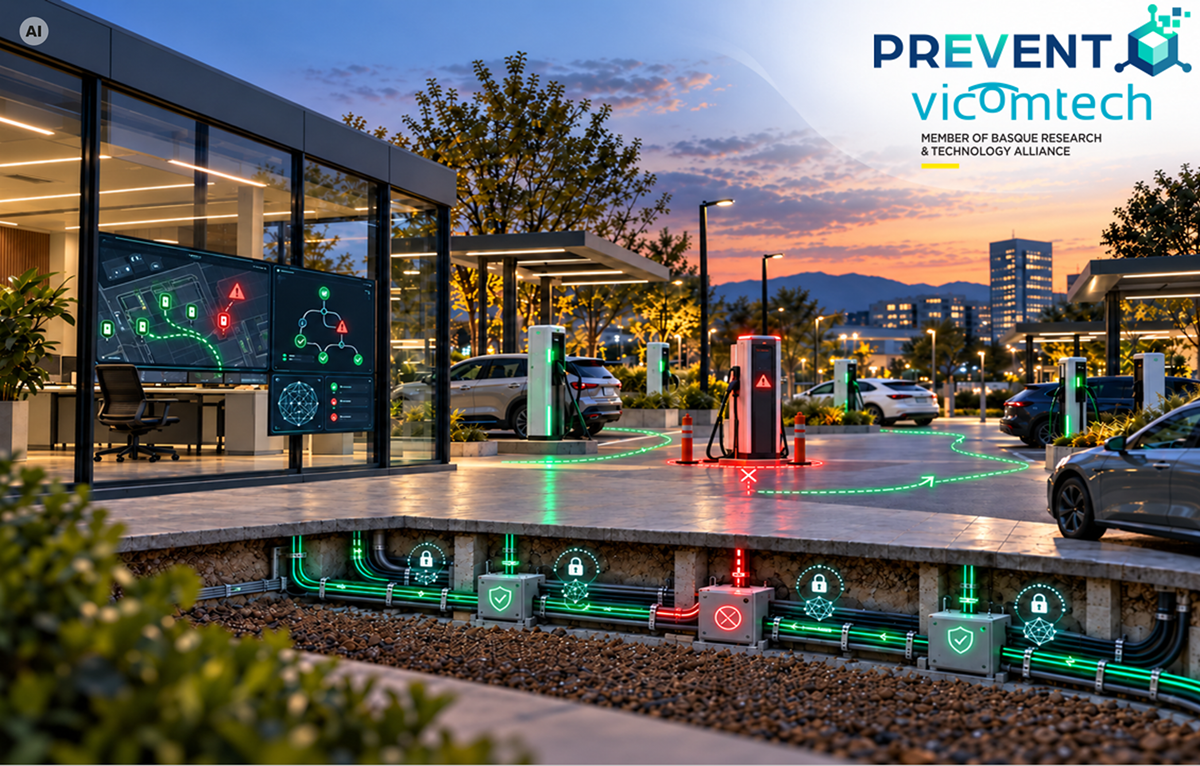
As electric vehicle (EV) charging networks and connected transport infrastructure expand rapidly across Europe, ensuring their cybersecurity has become a critical national and continental priority. The EU-funded Horizon Europe project PrEVent addresses these vulnerabilities by delivering Europe’s first end-to-end cybersecurity framework for the e-mobility ecosystem, fully aligned with the Cyber Resilience Act (CRA), NIS2 Directive, ISO/SAE 21434, and UNECE R155/156 regulations. Within this multi-partner initiative, Fundación Centro de Tecnologías de Interacción Visual y Comunicaciones VICOMTECH, an applied research centre based in San Sebastian and Bilbao (Spain), plays a central technical role through its Digital Security Department.
VICOMTECH specializes in Visual Computing, Interaction, and Artificial Intelligence, bringing high-level R&D capabilities to the consortium. In PrEVent, VICOMTECH leads Work Package 4 (WP4), focusing on rapid response and recovery mechanisms, while also driving key task leadership in Post-Quantum Public Key Infrastructure (PQ-PKI) governance and AI-driven security validation.
Leading AI-driven rapid response and recovery (WP4)
A primary responsibility for VICOMTECH in PrEVent is leading Work Package 4 (WP4), dedicated to developing Decision Support Systems (DSS) and fast reaction protocols for e-mobility systems. In Task 4.1, VICOMTECH leads the creation of the organizational Decision Support System (Res-OrgDSS), which automates organizational incident response and data breach handling. Res-OrgDSS utilizes Multi-Agent Reinforcement Learning (MARL) combined with Generative AI (GenAI) to provide human operators with intelligent, context-aware, and standards-aligned recommendations during live cyber incidents.
In Task 4.2, VICOMTECH leads the design of self-healing and automated fallback mechanisms (Rec-ICTDSS) for Electric Vehicle (EV) and Electric Vehicle Supply Equipment (EVSE) operations. This technology enables automated containment of live cyberattacks and executes tactical recovery protocols to sustain continuous operations under adversarial conditions. To power these systems, VICOMTECH leverages its proprietary ReactRL software library, an advanced reinforcement learning framework implementing algorithms such as QMIX and Double DQN for multi-agent competitive and cooperative scenarios.
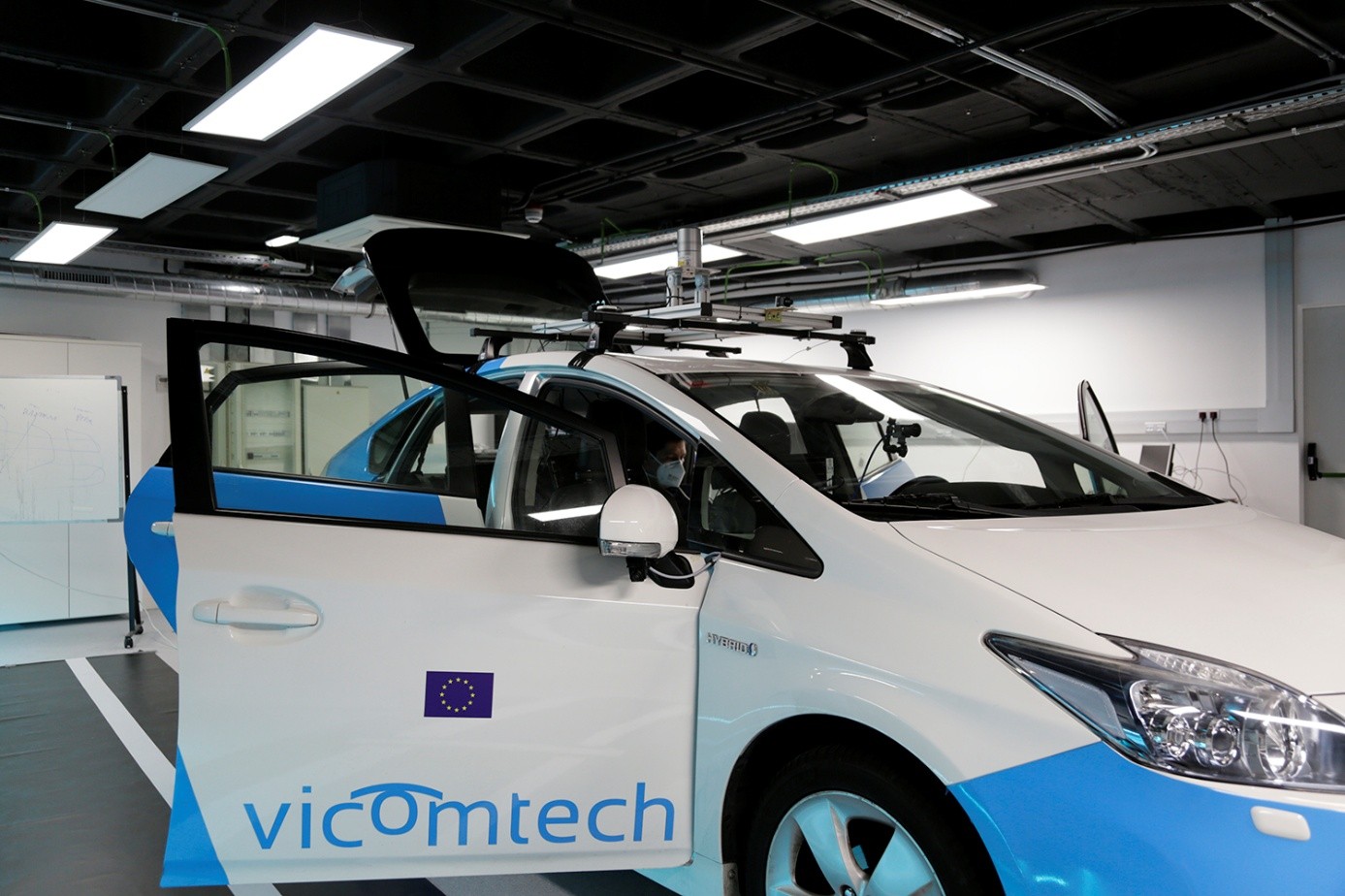
Post-Quantum cryptography and Zero Trust governance (Task 2.3)
Beyond response orchestration, VICOMTECH leads Task 2.3 within Work Package 2, focusing on enhancing Public Key Infrastructure (PKI) governance and cryptographic containment through Post-Quantum Cryptography (PQC) and Zero Trust architecture. As quantum computing advances, traditional cryptographic algorithms face future obsolescence; the PrePQ-PKI framework ensures long-term confidentiality, authenticity, and trust across Plug & Charge, roaming platforms, and Vehicle-to-Grid (V2G) transactions based on ISO 15118-20 standards.
To achieve quantum resilience, VICOMTECH integrates NIST-approved PQC algorithms (such as ML-DSA, FN-DSA, and ML-KEM) alongside its background IP library, Trivacy—a proprietary cryptographic software framework designed for privacy-preserving data processing, homomorphic encryption, and post-quantum protocols. Furthermore, VICOMTECH contributes its expertise in firmware behavior analysis, machine learning model validation, and graph-based AI (utilizing its Kriptosare and B-Have libraries) to evaluate the robustness of embedded devices and detect network traffic anomalies.
By combining secure-by-design principles, post-quantum trust architectures, and AI-powered autonomous response, PrEVent establishes Europe’s first end-to-end cybersecurity framework for clean, connected mobility.
Testing, validation, and real-world pilot deployment
VICOMTECH actively participates in validating PrEVent solutions across the project’s full development lifecycle. This includes contributing to threat modeling and Threat Analysis and Risk Assessment (TARA) in WP1, AI-enhanced Digital Twin (DeTwin) attack simulations and Federated Learning Intrusion Detection (DeFed) in WP3, as well as laboratory testing and secure testbed campaigns in WP5.
Finally, VICOMTECH will support the on-field integration and validation of these solutions across real-life pilot sites in Europe, including public e-bus depots in Madrid, V2G car-sharing networks in Ljubljana, automated charging stations in Hannover, and commercial logistics fleets in the UK. Through these combined efforts, VICOMTECH is helping to establish a certifiable, resilient, and future-proof e-mobility ecosystem for Europe.
Authors: Dimitra Graikini, Daniel García Paredes
Links
https://www.vicomtech.org/en/research/technology/digital-security